
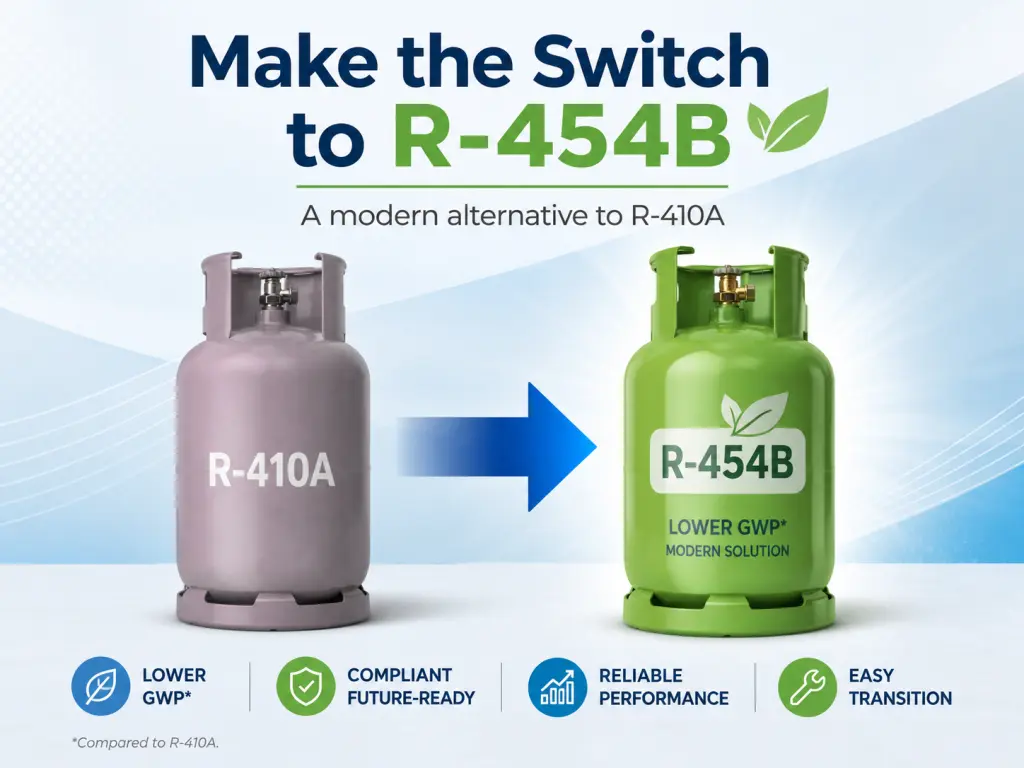
If you have priced a new air conditioner in the past year, you have probably heard the term R-454B and wondered whether it changes your decision. The short answer: new residential systems sold today are built for R-454B rather than R-410A, that shift affects equipment, installation practices, and pricing across the industry, and your existing R-410A system is still perfectly legal to run and repair. Nothing about the change forces a Bradenton homeowner to replace a system that is working.
What it does change is how you should think about timing, what you should expect on a replacement quote, and which questions are worth asking before you sign anything.
What Actually Changed
Under federal rules phasing down high global-warming-potential refrigerants, manufacturers stopped producing new residential air conditioners and heat pumps charged with R-410A as of January 1, 2025. The replacement for most residential equipment is R-454B, a refrigerant with a substantially lower global warming potential.
R-454B is classified as an A2L refrigerant, which means it is mildly flammable. That classification is the reason the transition is more than a label swap. Equipment designed for A2L refrigerants includes different safety features, and technicians work with different tooling, leak-detection requirements, and handling procedures than they did with R-410A.
Your current system is not obsolete
This is the point that gets lost most often. If your home has an R-410A system:
- It is legal to keep running for as long as it lasts.
- It is legal to service and repair.
- R-410A is still available for recharging existing equipment.
The calendar flipping does not shorten your system’s life. What the phase-down does mean is that R-410A is a refrigerant on its way out of production over time, and supply for legacy refrigerants generally tightens as a phase-down progresses. That matters most for older systems that already leak.
Why This Changes the Repair-or-Replace Math in Bradenton
Bradenton air conditioners work a schedule that homeowners farther north simply do not. Cooling season here runs the better part of the year, and a system carrying a slow refrigerant leak accumulates runtime hours fast. When a repair estimate involves a significant recharge on an aging R-410A system, the underlying question is no longer just “is this repair worth it?” It is “how many more seasons am I buying, and at what refrigerant cost each time?”
A reasonable way to think about it:
- A young system with a fixable leak. Repair it. Find and fix the leak rather than repeatedly topping off the charge, which is both expensive and bad for the equipment.
- A system in its mid-teens with a major failure. This is where the comparison gets real. A compressor or coil replacement on a system that is already near the end of its service life rarely pencils out against a new, more efficient system.
- A system that is still cooling well. Leave it alone and maintain it. There is no regulatory reason to replace working equipment.
If you are working through that comparison, our air conditioning repair team can diagnose what is actually wrong before anyone starts talking about replacement.
What to Expect on a New Installation
A few practical differences show up on an R-454B installation compared with what you may remember from your last system:
Equipment and materials
Manufacturers redesigned indoor and outdoor units for A2L compatibility. Some systems include refrigerant leak detection that will shut the system down and run the blower if a leak is sensed. Line sets, service valves, and certain components have their own compatibility requirements.
Installation practices
Technicians handling A2L refrigerants follow different storage, transport, and jobsite procedures, and installers use tooling rated for the refrigerant. Practically, this means the contractor’s training and certification matter more than they did a few years ago.
Pricing
Across the industry, equipment built for the new refrigerant has generally carried higher costs than the models it replaced. We do not quote prices in an article because a real number depends on your home’s load, ductwork, electrical, and the equipment you choose. What we can tell you is that a quote from three or four years ago is not a useful benchmark today. Get a current estimate for your actual house.
When you are ready, you can request an estimate and we will size and price the system for your home rather than a generic square-footage rule of thumb.
Questions Worth Asking Any Contractor Right Now
- Is this quote for an R-454B system, and is it current model-year equipment? You want to know exactly what you are buying.
- Did you perform a load calculation? Sizing matters more in our climate than almost anywhere, because an oversized system cools quickly and leaves the house damp.
- Are your technicians trained and equipped for A2L refrigerants? A fair question, and any good contractor will answer it plainly.
- What happens to my line set? Reuse is sometimes possible and sometimes not. The answer should be based on inspection, not assumption.
- What does the warranty require of me? Most manufacturer warranties require registration and documented annual maintenance.
How to Plan Your Replacement Timing
The homeowners who come out best are the ones who plan a replacement rather than react to a failure in August. A planned changeout means you compare options, choose equipment on efficiency and comfort rather than on what is on the truck, and schedule the work when it is convenient.
If your system is in its mid-teens or older, the reasonable move is a straightforward assessment now: system age, refrigerant condition, efficiency, and how it has been performing. That gives you a real timeline instead of a guess. Our maintenance club members get that assessment as part of regular service, and enrolled equipment tends to reach its full service life rather than falling short of it.
For homeowners who decide it is time, our air conditioning installation team handles sizing, permitting, and installation, and there are financing options available if that helps the timing work.
The Bottom Line
R-454B is a real change to how new systems are built and installed, but it is not an emergency for anyone with a functioning air conditioner. Keep your current system maintained. If it starts leaking refrigerant or reaches the age where major repairs stop making sense, make the replacement decision on the merits of your specific system, with a current quote and a proper load calculation.
McDonald Home Services serves Bradenton and the surrounding communities. If you want a clear read on where your system stands before the next cooling season, schedule service and we will give you an honest assessment.
Frequently Asked Questions
Do I have to replace my R-410A air conditioner?
No. The rule applies to the manufacture of new equipment, not to systems already installed. Your R-410A system is legal to operate and legal to service, and R-410A remains available for repairing existing units.
Is R-454B dangerous because it is flammable?
R-454B is classified as A2L, or mildly flammable, which is a lower-risk category than the flammable gases people typically picture. Equipment is designed with that classification in mind, including leak detection on many systems, and technicians follow specific handling procedures. Installed correctly by a trained contractor, it is safe for residential use.
Will my repair costs go up if I keep my old system?
Standard repairs such as capacitors, contactors, motors, and drain work are unaffected. The cost that can move is refrigerant itself, since R-410A is no longer being produced for new equipment. If your system needs repeated recharges, that is a signal to address the leak or evaluate replacement rather than to keep adding refrigerant.
Can a technician convert my existing system to R-454B?
No. Retrofitting an R-410A system to R-454B is not an approved practice. The refrigerants are not interchangeable, and the equipment is engineered for a specific refrigerant. Switching means new equipment.
Should I have bought a system before the change to save money?
It is not worth second-guessing. Buying an air conditioner you did not need in order to get an older refrigerant would have meant paying for equipment years early and losing efficiency gains. The better strategy is the same as it always was: maintain what you have, and replace it when the system tells you it is time.

Bob Bermudez, MBA, is the President and Owner of McDonald Home Services (Jim McDonald & Sons Heating & Cooling), a family-run HVAC and plumbing company serving Bradenton, Sarasota, and Manatee County since 1970. Before buying the company, Bob spent his career on the manufacturing and distribution side of HVAC — a background that shapes how he advises homeowners on equipment.